
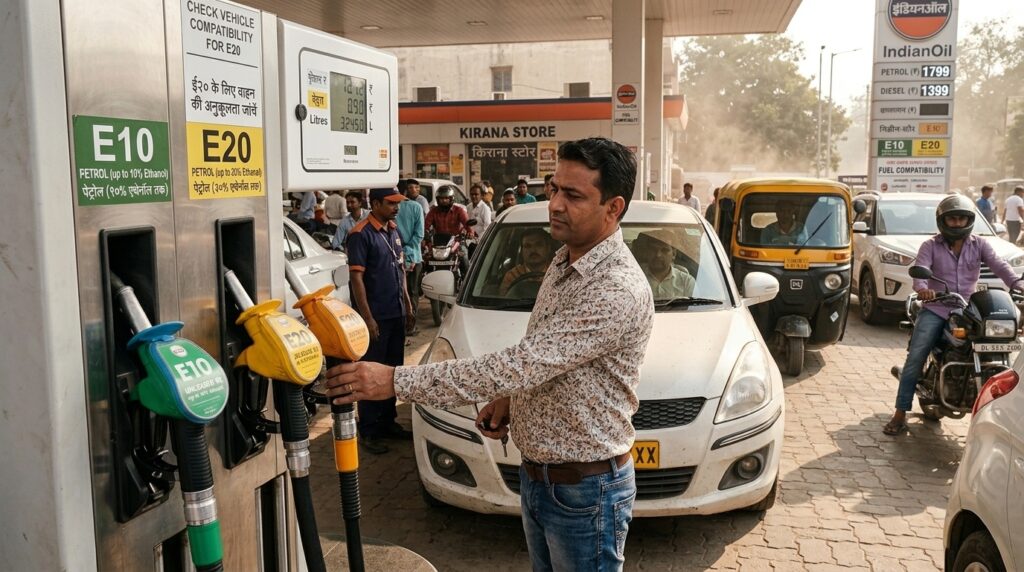
SIAM Urged Government to Retain E10 Fuel Alongside E20 to Protect Existing Vehicles
The Society of Indian Automobile Manufacturers (SIAM) had recommended that the Indian government continue supplying E10 petrol even after the nationwide rollout of E20 fuel, according to a 2021 report by NITI Aayog that has recently gained attention.
While SIAM supported India’s ethanol blending programme, it warned that removing E10 fuel entirely could create compatibility, safety and fuel efficiency issues for millions of vehicles currently on Indian roads.
The discussion has resurfaced as reports suggest the government may adopt a phased approach before introducing higher ethanol blends such as E25 petrol.
Why SIAM Wanted E10 Fuel to Continue
In its roadmap submitted to the government, SIAM highlighted that a large number of vehicles were originally engineered to run on E10 petrol.
The industry body recommended that E10 should continue to be available alongside E20 to ensure:
- Compatibility with older vehicles
- Better fuel efficiency
- Improved drivability
- Reduced risk of component damage
- Greater consumer confidence during the transition
According to SIAM, maintaining a “protection grade” E10 fuel would help existing vehicle owners avoid potential issues while newer E20-compatible vehicles gradually become more common.
Concerns Over Existing Vehicle Fleet
India currently has millions of vehicles that were manufactured before E20-compatible engines became standard.
Broadly, vehicles fall into three categories:
| Vehicle Manufacturing Period | Ethanol Compatibility |
|---|---|
| Before April 2023 | Primarily E10 compatible |
| April 2023 – March 2025 | Material compatible with E20 but not fully optimised |
| April 2025 onwards | Fully E20 compliant |
This means a significant number of passenger vehicles and two-wheelers were originally designed for lower ethanol concentrations.
Possible Challenges with Higher Ethanol Blends
SIAM and industry experts have identified several concerns if ethanol blending levels increase without adequate preparation.
Fuel Efficiency
Ethanol contains less energy than petrol, which can reduce fuel economy.
SIAM estimated that E20 petrol could lower fuel efficiency by around 6%, while many manufacturers have suggested a reduction of approximately 3–4% depending on the vehicle and driving conditions.
Higher blends such as E25 could further impact mileage if engines are not specifically calibrated.
Material Compatibility
Older fuel systems may not be designed for prolonged exposure to higher ethanol concentrations.
Components that could be affected include:
- Rubber hoses
- Fuel seals
- Plastic fuel system parts
- Fuel pumps
- Injector components
Over time, this may lead to increased wear or fuel system degradation in vehicles not engineered for higher ethanol blends.
Maintenance and Drivability
Industry experts have also highlighted possible concerns such as:
- Increased maintenance requirements
- Replacement of ageing fuel system components
- Reduced drivability in some low-powered vehicles
- Potential engine recalibration requirements
These concerns become more significant as ethanol concentration increases beyond E20.
Government May Delay Mandatory E25 Rollout
Recent reports suggest the government is considering a phased approach rather than immediately mandating E25 petrol across the country.
Authorities are currently evaluating:
- Vehicle compatibility
- Fuel economy impacts
- Long-term durability
- Emissions performance
- Consumer acceptance
This approach would allow additional technical studies before introducing higher ethanol blends nationwide.
Flex-Fuel Vehicles Seen as the Long-Term Solution
Instead of modifying millions of existing vehicles, the industry believes flex-fuel vehicles (FFVs) offer a more practical long-term solution.
Flex-fuel vehicles are designed to automatically adjust to different ethanol concentrations and can operate on multiple fuel blends, making them better suited for future fuels such as:
- E20
- E25
- E30
- E85
Several manufacturers have already showcased flex-fuel products as India prepares for the next phase of its biofuel strategy.
India’s Ethanol Mission Continues
Despite the debate over E10 and E25, the government’s commitment to ethanol blending remains unchanged.
India successfully achieved 20% ethanol blending in petrol (E20) ahead of schedule, with the programme aimed at:
- Reducing crude oil imports
- Improving energy security
- Lowering emissions
- Supporting farmers
- Expanding the domestic biofuel industry
Future policy decisions are expected to balance these environmental and economic objectives with the practical needs of existing vehicle owners.