
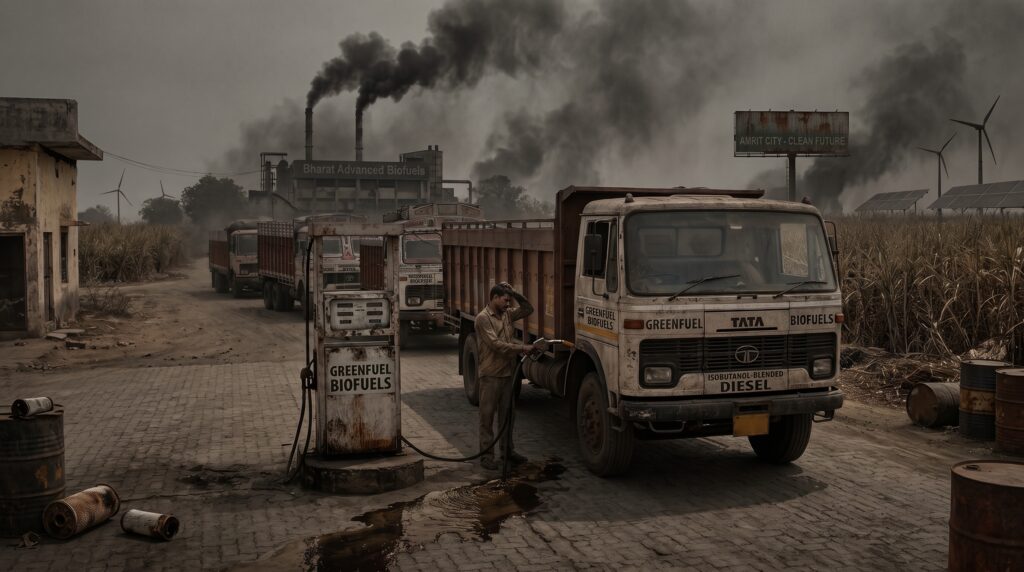
India Plans Up to 15% Isobutanol Blending in Diesel; Nitin Gadkari Unveils Next Biofuel Initiative
The Indian government is preparing for the next phase of its alternative fuel strategy by planning to allow up to 15% isobutanol blending in diesel. The announcement was made by Union Minister for Road Transport and Highways Nitin Gadkari, as part of the government’s broader effort to reduce dependence on imported crude oil and promote cleaner fuels.
The move follows India’s successful rollout of 20% ethanol blending (E20) in petrol and marks another step toward strengthening the country’s biofuel ecosystem.
Government Plans 15% Isobutanol Blend in Diesel
According to Nitin Gadkari, ethanol cannot be blended directly with diesel due to technical limitations. To overcome this challenge, the government is focusing on converting ethanol into isobutanol, which can be blended with diesel more effectively.
The proposed policy would allow diesel to contain up to 15% isobutanol, helping reduce fossil fuel consumption while maintaining compatibility with existing diesel engines.
Pilot projects have already demonstrated encouraging results, with engines successfully operating on ethanol- and isobutanol-based fuels.
What Is Isobutanol?
Isobutanol is considered a next-generation biofuel that offers several advantages over conventional biofuels.
Some of its key benefits include:
- Higher energy density than ethanol
- Better compatibility with diesel engines
- Lower emissions
- Improved storage and transportation characteristics
- Reduced dependence on imported petroleum
Because of these advantages, isobutanol is increasingly being viewed as a practical alternative fuel for diesel-powered vehicles and equipment.
Successful Pilot Demonstrations
Speaking about the progress of the initiative, Gadkari revealed that pilot demonstrations have already shown promising outcomes.
According to the minister, generator sets have successfully operated on 100% ethanol and isobutanol, demonstrating that engines can be developed to run efficiently on these fuels.
These trials are expected to pave the way for wider commercial adoption in the coming years.
Why Is India Promoting Biofuels?
India imports a significant portion of its crude oil requirements, making fuel imports a major burden on the economy.
The government’s biofuel strategy aims to:
- Reduce crude oil imports
- Improve India’s energy security
- Lower greenhouse gas emissions
- Support domestic biofuel production
- Increase income opportunities for farmers by creating demand for ethanol feedstock
The proposed isobutanol blending programme is expected to further strengthen these objectives.
E20 Programme Sets the Foundation
The announcement comes shortly after India achieved its target of 20% ethanol blending in petrol (E20) ahead of schedule in December 2025.
According to official government figures, the ethanol programme has already resulted in:
- Foreign exchange savings of over ₹1.9 lakh crore
- Reduced crude oil imports
- Lower carbon emissions
- Additional income opportunities for farmers
Building on this success, the government is now looking to replicate similar benefits in the diesel segment through isobutanol blending.
What Does It Mean for Diesel Vehicle Owners?
At present, the government has only outlined its roadmap, and the proposal is still under development.
If implemented, diesel users may benefit from:
- Cleaner-burning fuel
- Reduced emissions
- Lower dependence on imported fuel
- Greater use of domestically produced biofuels
The government is expected to introduce blending norms gradually after further testing and regulatory approvals.